
Learn the real legal facts about property ownership in Hurghada and Egypt’s Red Sea region, including POAs, contracts, resales, and foreign buyer rules.
Property Ownership in Hurghada & the Red Sea: Legal Guide for Foreign Buyers
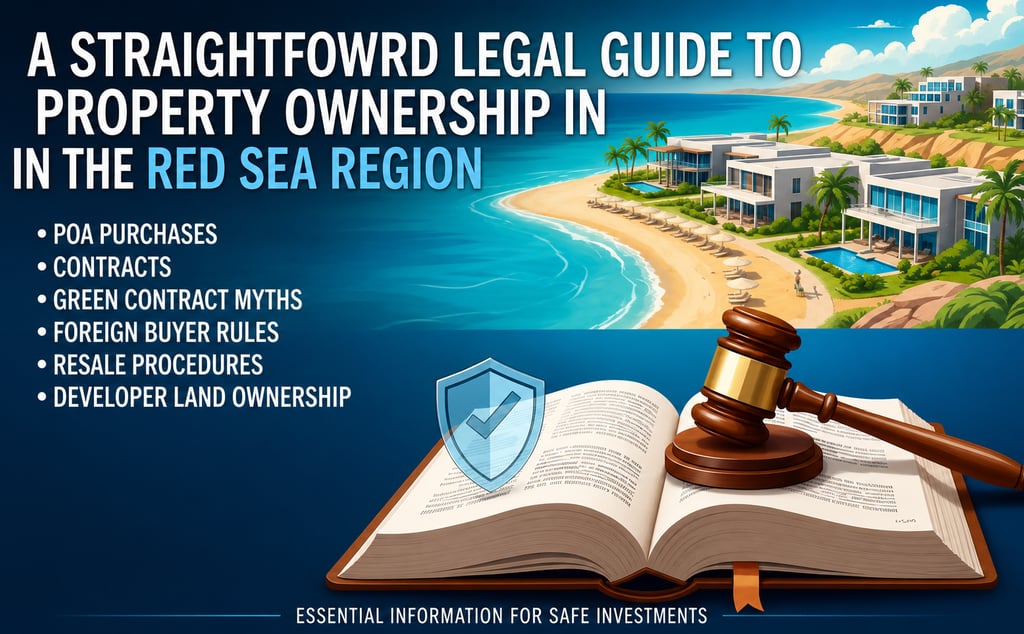
Buying property in Egypt’s Red Sea region — including destinations such as Hurghada, Sahl Hasheesh, El Gouna, and Port Ghalib — has become increasingly popular among international investors and holiday-home buyers.
However, many foreign buyers receive conflicting legal advice regarding contracts, Power of Attorney (POA), “green contracts,” and ownership rights. Understanding how property ownership actually works in practice is essential for making a safe and informed investment.
This guide explains the legal realities of property ownership in the Red Sea region in a straightforward and practical way.
Property Ownership in the Red Sea Region – Legal Overview
There are several forms of property ownership commonly used throughout the Red Sea area. Understanding these ownership structures helps buyers protect themselves legally and avoid unnecessary risks or misleading information.
1. Direct Purchase from the Developer
The most common and straightforward method is purchasing directly from the developer through an official sales contract.
Once all contractual payments are completed, the developer should issue:
• A final purchase contract
• A Power of Attorney (POA) authorizing the buyer’s ownership rights
• Permission for future resale, management, or transfer of the property
In practical terms, this is the standard ownership structure used for most foreign buyers in the Red Sea region.
When the developer legally owns the land and the project documentation is properly verified, this form of ownership is widely accepted and commonly used throughout the market.
2. Purchasing Through an Existing POA
In resale transactions, properties are often transferred through an existing Power of Attorney issued by the previous owner.
This method is legally recognized in Egypt and is frequently used in the Red Sea property market.
However:
• A purchase contract combined with a POA is generally stronger than relying on a POA alone
• Buyers should always request as much supporting documentation as possible
• Original paperwork should be reviewed carefully before purchase
The more complete the legal documentation, the safer the buyer’s position becomes.
The Truth About “Green Contracts”
One of the biggest misconceptions in the Red Sea property market concerns the so-called “green contract.”
Some lawyers or agents claim that a green contract (full registration) is the only secure form of ownership. In reality, the situation is more complex.
A buyer’s position is generally considered secure when:
• The developer legally owns the land
• The property documentation is valid
• The transaction is conducted correctly
• The sale comes directly from the developer or through a verified ownership chain
In practice, it is extremely rare for foreign buyers in Hurghada and the surrounding Red Sea region to obtain full property registration in their own personal name.
Many buyers are promised full registration after paying legal fees, only to discover years later that the process was rejected or never completed.
For this reason, buyers should focus less on marketing terminology and more on verifying the actual legal documentation behind the property.
Legal Reality for Foreign Buyers in Egypt
Under Egyptian law, foreign nationals are generally permitted to own up to two residential properties.
However, because foreign buyers rarely obtain full registration in practice, this limitation is not commonly enforced in the Red Sea market. Many foreign investors legally own multiple units without issue.
The most important legal procedure many independent lawyers can reliably provide after purchase is known as:
Court Signature Validation (Siḥḥat Tawqīʿ)
This court procedure verifies that the signature on the purchase contract genuinely belongs to the seller or developer.
This is particularly valuable for:
• Off-plan purchases
• Under-construction projects
• Additional legal reassurance
• Dispute prevention
While it does not replace full registration, it provides an additional layer of legal protection.
Resale Properties and Multiple POAs
When purchasing a resale property, buyers may discover several POAs within the ownership history.
This is common in the Red Sea market and does not automatically indicate a legal problem.
To ensure a safe transfer:
• Each POA should be reviewed carefully
• The ownership chain should remain continuous and traceable
• Original documents should be collected whenever possible
• Buyers should request a fresh purchase contract from the current seller alongside the latest POA
Proper due diligence is essential in resale transactions.
Developers and Chains of Land Ownership
Not all developers acquire land in the same way.
Some developers purchase land directly from the local authorities or City Council, while others acquire land through previous owners or investment partnerships.
As a result, multiple POAs may appear throughout the land ownership history.
This alone is not necessarily a legal concern — provided that:
• The developer’s legal team has properly verified the ownership chain
• The land documents are authentic and complete
• No legal disputes exist over the property
A professionally verified ownership chain is one of the most important factors when assessing any real estate investment in Egypt.
Final Recommendation for Foreign Buyers
Every development in the Red Sea region has its own legal structure, ownership history, and documentation.
Before purchasing any property, buyers should:
• Appoint an independent and trustworthy lawyer
• Verify the developer’s ownership documents
• Review all contracts carefully
• Confirm the validity of POAs and ownership history
• Avoid relying solely on marketing claims or verbal promises
An experienced independent lawyer can help identify risks early and ensure the transaction is completed correctly.
When approached carefully and professionally, property investment in Egypt’s Red Sea region can offer strong value, excellent lifestyle opportunities, and long-term investment potential for foreign buyers.